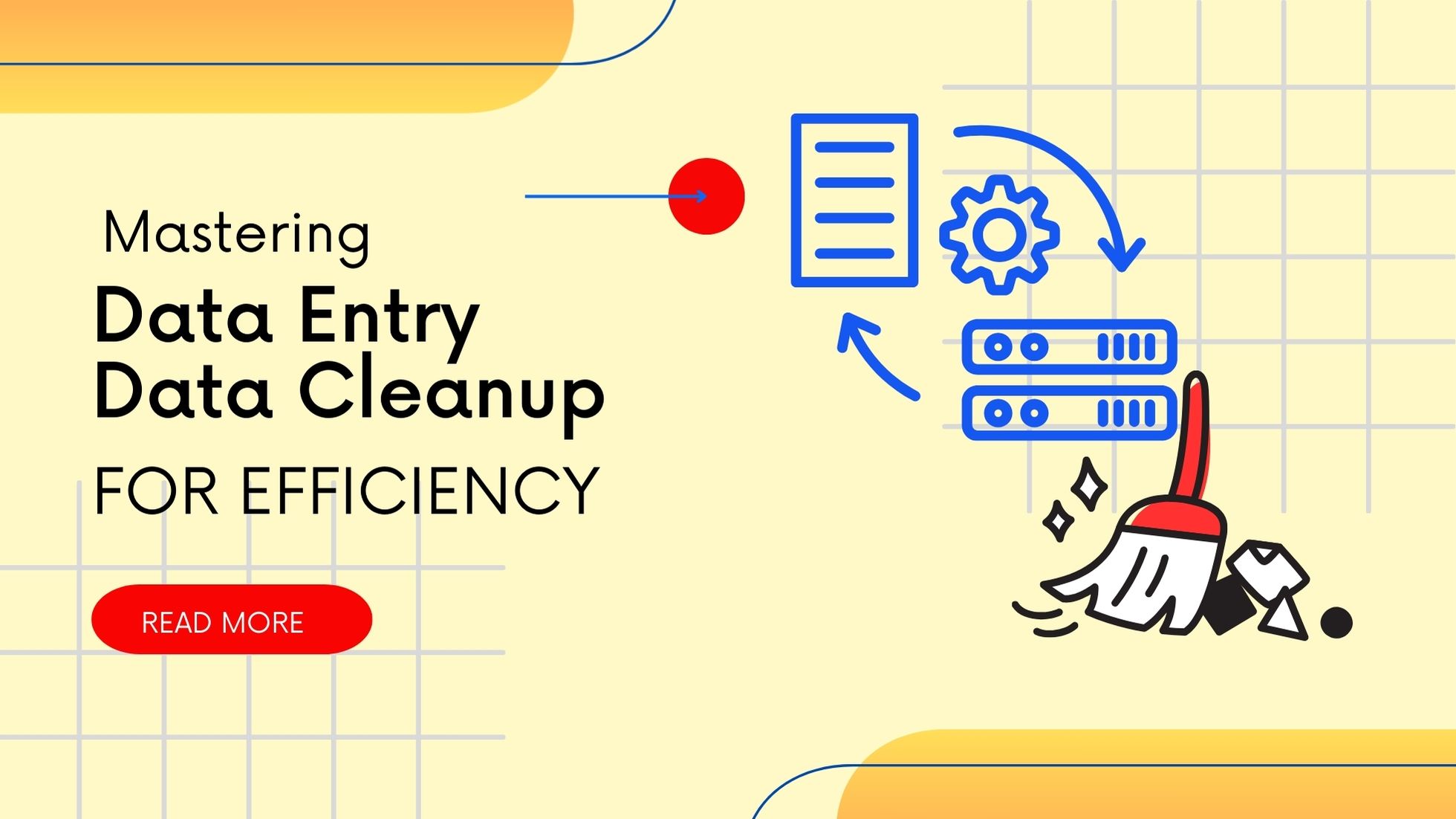
Mastering Data Entry and Data Cleanup for Efficiency
In today’s data-driven world, accurate and well-organized data is the lifeblood of any successful organization. Poor data quality can lead to flawed decision-making, wasted resources, and ultimately, lost revenue. That’s where expert data entry and data cleanup services come in.
Data entry, while often perceived as a simple task, requires meticulous attention to detail and a commitment to accuracy. From manually inputting information from various sources to digitizing physical documents, the process demands precision to avoid errors that can cascade through your systems.
The Importance of Data Cleanup
Even with careful data entry practices, data naturally degrades over time. Information becomes outdated, duplicates creep in, and inconsistencies arise. Data cleanup, also known as data cleansing or data scrubbing, is the process of identifying and correcting these errors. This involves:
- Removing duplicates: Eliminating redundant entries to ensure accurate counts and reporting.
- Correcting errors: Fixing typos, misspellings, and inaccurate information.
- Standardizing formats: Ensuring consistency in date formats, addresses, and other data fields.
- Filling in missing data: Where possible, completing incomplete records to maximize data utility.
Clean data provides a reliable foundation for analytics, reporting, and automated processes, empowering businesses to make informed decisions and optimize operations. A study by Gartner found that poor data quality costs organizations an average of $12.9 million per year , highlighting the significant financial impact of neglecting data hygiene.
Beyond Basic Data Entry and Cleanup: Expert Virtual Assistant Support
For startups, founders, agencies, and busy professionals, managing data entry and cleanup in-house can be a drain on valuable time and resources. Delegating these tasks to expert virtual assistants (VAs) offers a cost-effective and scalable solution.
By leveraging the expertise of skilled VAs, businesses can ensure accurate data entry, consistent data cleanup, and ultimately, a healthier data environment that supports growth and success. These VAs can also handle a variety of administrative, tech, customer support, marketing, creative tasks, or executive work — and a Dedicated Supervisor manages your VA, shift, processes, and reporting so you don’t have to.
Why Data Entry and Cleanup Matters for US Businesses
In today’s data-driven landscape, accurate and well-organized data is the bedrock of successful US businesses. Data entry and data cleanup, while often perceived as tedious, are fundamental administrative processes that directly impact key operational areas. Neglecting these crucial tasks can lead to significant repercussions, affecting everything from customer satisfaction to strategic decision-making.
The Impact of Accurate Data on Business Operations
Clean and accurate data empowers businesses to make informed decisions. Imagine relying on sales reports built on faulty data – marketing campaigns might be misdirected, inventory levels could be inaccurately managed, and ultimately, revenue could suffer. Accurate data entry and regular cleanup ensure that the information fueling your business strategies is reliable and trustworthy. It enables efficient resource allocation, targeted marketing efforts, and improved forecasting capabilities.
Beyond strategic decision-making, accurate data directly affects operational efficiency. Consider customer relationship management (CRM) systems. If customer data is riddled with errors or duplicates, sales and support teams will struggle to personalize interactions, potentially leading to lost opportunities and dissatisfied customers. Investing in effective data entry and cleanup processes is an investment in smoother operations and a better customer experience.
Avoiding Costly Errors and Compliance Issues
Inaccurate data can lead to costly errors, ranging from miscalculated invoices to incorrect deliveries. These errors not only erode customer trust but also consume valuable time and resources to rectify. Furthermore, in regulated industries, inaccurate data can result in non-compliance issues, leading to fines and legal penalties. Maintaining data integrity through meticulous data entry and regular cleanup is essential for mitigating these risks.
Leveraging Virtual Assistants for Efficient Data Management
Many US businesses, particularly startups and small to medium-sized enterprises (SMEs), are turning to expert virtual assistants (VAs) to handle their data entry and cleanup needs. This approach offers a cost-effective solution for ensuring data accuracy without the overhead of hiring full-time staff. VAs can be assigned to specific data-related tasks, allowing businesses to focus on their core competencies. Flexible hourly or team-based plans are often available, enabling businesses to scale their support as needed.
For example, businesses can leverage VAs to manage CRM data entry, clean up existing databases, and ensure data consistency across various platforms. This allows businesses to maintain data integrity, improve operational efficiency, and ultimately drive growth.
Top Data Cleanup Techniques for Accuracy
Ensuring data accuracy is paramount for making informed business decisions. Inaccurate data leads to flawed insights, wasted resources, and potentially damaging outcomes. Data cleanup, also known as data cleansing or scrubbing, is the process of identifying and correcting errors, inconsistencies, and redundancies within a dataset. This section outlines several effective techniques to achieve data accuracy.
1. Data Profiling and Auditing
Before you can clean your data, you need to understand its current state. Data profiling involves examining the data to identify patterns, anomalies, and potential errors. This includes checking for missing values, incorrect data types, and invalid entries. Auditing processes should track the source of data and any transformations it undergoes, providing a clear lineage for identifying the origin of errors. Data profiling tools can automate much of this process, generating reports that highlight areas needing attention. This provides a foundation for targeted cleanup efforts.
2. Standardization and Formatting
Inconsistent formatting is a common source of data inaccuracies. Standardizing data involves ensuring that all entries conform to a consistent format. This includes standardizing date formats (e.g., YYYY-MM-DD), address formats, and abbreviations. For example, ensuring all phone numbers adhere to a specific format like (XXX) XXX-XXXX. Consistent formatting not only improves data readability but also facilitates accurate analysis and comparison. Virtual assistants often play a key role in manually reviewing and standardizing data across large datasets.
3. Deduplication
Duplicate records can skew data analysis and lead to inefficiencies. Deduplication involves identifying and removing or merging duplicate entries within a dataset. This can be achieved through various methods, including fuzzy matching algorithms and manual review. Fuzzy matching can identify records that are similar but not exact matches, such as “John Smith” and “Jon Smith.” Removing duplicates ensures that your analysis is based on unique data points, leading to more accurate results.
4. Validation and Verification
Data validation involves checking data against predefined rules and constraints to ensure its accuracy and completeness. This can include validating data types, checking for required fields, and verifying data against external sources. For example, verifying addresses against a postal database. Verification often requires manual review by a trained professional to confirm the accuracy of specific details and resolve ambiguous cases.
5. Error Correction and Imputation
Once errors are identified, they need to be corrected. This can involve manually editing incorrect entries, using automated correction tools, or imputing missing values. Imputation involves replacing missing values with estimated values based on other data points. However, imputation should be used cautiously, as it can introduce bias if not done correctly. A common approach is to use statistical methods or domain expertise to estimate missing values based on the available data. Data entry and data cleanup virtual assistants can accurately perform error correction and imputation.
Streamline Data Entry for Efficiency Gains
Accurate and efficient data entry is crucial for any successful organization. However, manual data entry can be time-consuming, prone to errors, and drain valuable resources that could be better allocated to strategic initiatives. Investing in streamlined data entry processes and robust data cleanup practices is key to unlocking efficiency gains and improving overall productivity.
The Impact of Efficient Data Entry
When data is entered correctly and consistently, it reduces the need for rework, improves data quality, and facilitates informed decision-making. Consider the scenario where a marketing campaign relies on inaccurate customer data – this could lead to wasted marketing spend and missed opportunities. In contrast, a streamlined data entry process can significantly minimize such risks.
Poor data quality, stemming from inefficient data entry, can impact various aspects of a business. Here are some key benefits that come with improved data entry processes:
- Reduced Errors: Minimizing manual input reduces the likelihood of typos and inconsistencies.
- Faster Processing Times: Streamlined processes lead to quicker turnaround times for tasks relying on accurate data.
- Improved Data Quality: Consistent and accurate data entry results in a higher quality database, enhancing overall business intelligence.
- Cost Savings: Reducing errors and improving efficiency translates to significant cost savings in the long run.
Data Cleanup: Maintaining Data Integrity
Even with efficient data entry processes in place, data quality can deteriorate over time. Data cleanup, or data cleansing, is the process of identifying and correcting inaccuracies, inconsistencies, and redundancies in a dataset. This includes tasks such as:
- Removing duplicate entries
- Correcting spelling errors and typos
- Standardizing data formats
- Filling in missing values
Regular data cleanup is essential for maintaining data integrity and ensuring that the data used for analysis and decision-making is accurate and reliable. This is particularly important as organizations grow and accumulate larger volumes of data.
Optimizing Your Data Entry Workflow
Companies may struggle with improving data entry and data cleanup. Delegating these tasks to a trained virtual assistant can drastically streamline operations. Startups, founders, and busy professionals can leverage expert support to handle these essential, yet often time-consuming, administrative tasks. With flexible hourly or team-based plans, it is possible to get support for admin tasks, ensuring data is accurate and up-to-date, without needing to manage shift, processes, and reporting. This lets organizations focus on core business functions while maintaining data integrity.
FAQ: Data Entry and Cleanup
Data entry and data cleanup are fundamental administrative processes that directly impact the accuracy and reliability of your business information. Getting it right ensures better decision-making, improved operational efficiency, and ultimately, a healthier bottom line. Here are some frequently asked questions to help you understand more about these crucial tasks and how leveraging expert virtual assistance can streamline the process.
Why is Accurate Data Entry So Important?
Inaccurate data can lead to a cascade of problems. Imagine marketing campaigns targeting the wrong audience, sales teams chasing outdated leads, or financial reports reflecting incorrect revenue. The consequences range from wasted resources and lost sales to damaged reputation and compliance issues. Accurate data entry forms the foundation for informed decision-making across all departments.
What are the Common Challenges in Data Entry?
Several factors contribute to errors in data entry, including:
- Human error (typos, misinterpretations)
- Inconsistent data formats
- Lack of standardized processes
- Poor data validation mechanisms
- Time constraints and pressure to rush the process
Overcoming these challenges requires a systematic approach, meticulous attention to detail, and often, the implementation of automated tools and standardized procedures.
What Does Data Cleanup Entail?
Data cleanup, also known as data cleansing or data scrubbing, is the process of identifying and correcting inaccuracies, inconsistencies, and redundancies in a dataset. This often involves:
- Removing duplicate entries
- Standardizing data formats (e.g., date formats, address formats)
- Correcting typos and misspellings
- Filling in missing information (where possible and accurate)
- Verifying data against reliable sources
Clean data is essential for accurate analysis, reporting, and decision-making.
What are the Benefits of Outsourcing Data Entry and Cleanup?
Outsourcing data entry and cleanup to a skilled virtual assistant offers several advantages:
- Improved Accuracy: Dedicated VAs are trained to perform these tasks with meticulous attention to detail.
- Increased Efficiency: VAs can handle large volumes of data quickly and efficiently, freeing up your in-house team to focus on strategic activities.
- Reduced Costs: Outsourcing can be more cost-effective than hiring and training full-time employees.
- Access to Expertise: You gain access to specialized skills and knowledge in data management.
- Scalability: You can easily scale your data entry and cleanup efforts up or down as needed, based on your business requirements.
How Can a Virtual Assistant Help with Data Entry and Cleanup?
A virtual assistant can handle a wide range of data entry and cleanup tasks, including:
- Entering data from various sources (e.g., spreadsheets, documents, online forms)
- Updating and maintaining databases
- Cleaning and standardizing data
- Performing data validation and quality checks
- Creating reports and summaries
- Managing customer contact information
What Types of Plans Are Available for Data Entry and Cleanup Support?
You can typically choose from flexible hourly or dedicated plans, depending on your needs. Hourly plans offer flexibility for smaller, ad-hoc projects. Dedicated plans provide consistent, ongoing support for larger data management tasks. Some services, offer curated Hourly Monthly Plans (e.g., 5, 10, 20, 30 hours) or dedicated plans (e.g., 80 hours, 160 hours, or multi-VA setups). A Dedicated Supervisor often manages the VA, shift, processes, and reporting.
Conclusion: The Indispensable Role of Data Entry and Cleanup for Success
In today’s data-driven world, efficient and accurate data entry and meticulous data cleanup are no longer optional extras; they are fundamental requirements for business success. Investing in robust data management practices, whether through internal resources or expert external support, yields significant returns in improved decision-making, enhanced operational efficiency, and a more competitive edge.
The time and resources saved by offloading these tasks to qualified professionals can be re-invested into core business activities, strategic planning, and innovation. This allows you and your team to focus on what truly matters – growing your business and achieving your goals. A well-maintained database is the bedrock upon which effective strategies are built.
Streamlining Operations with Expert Assistance
For startups, founders, agencies, and busy professionals, managing data entry and cleanup in-house can be a drain on resources. Expert virtual assistant support offers a flexible and scalable solution. Dedicated Virtual Assistants can handle these tasks, freeing up valuable time and resources. With access to curated Hourly Monthly Plans or dedicated team options, businesses can tailor their support to their specific needs.
Taking the Next Step
Consider the potential impact of improved data quality on your business. From more accurate reporting to more effective marketing campaigns, the benefits are far-reaching. Investing in data entry and cleanup is an investment in your future. Start with understanding your current data quality, outline a clear procedure for your team and then consider the next step and choose the plan that is right for your business.