If you have ever planned a large event yourself, you know exactly where the stress lives. It is not in the keynote. It is not in the venue or the agenda. It is in the hundred moving parts that have to work in the background for the main experience to look effortless: registrations, confirmations, schedules, speaker coordination, attendee communications, on-the-day troubleshooting, and post-event follow-up.
For founders, coaches, and business owners running lean teams, managing all of that manually is not just exhausting. It pulls your attention away from the one thing that actually moves your business: being present, credible, and connected at the event itself.
In 2026, the businesses hosting impressive, well-run events are not necessarily those with the biggest in-house teams. They are the ones who have learned to delegate the logistics layer entirely to an AI-assisted virtual assistant.
The Problem with Manual Event Management
Most small and mid-sized businesses approach event planning the same way they approach everything else: by assigning it to whoever has the most bandwidth at the time. That person then juggles registrations in a spreadsheet, chases speaker confirmations by email, sends reminders manually, and spends the days before the event firefighting problems that could have been anticipated weeks earlier.
The result is an event that looks fine from the outside but costs far more in internal time and stress than it should. And after the event, when the follow-up window is at its most valuable, the team is too exhausted to act quickly.
This is not a resourcing problem. It is a systems problem. And a skilled virtual assistant, equipped with the right AI tools, solves it by building those systems before the planning chaos begins.
What AI-Assisted Event Management Actually Looks Like
When a virtual assistant takes ownership of your event logistics, the process shifts from reactive to predictive. Instead of managing problems as they arise, a well-prepared VA anticipates them before they happen and builds automated workflows that handle routine tasks without anyone having to think about them.
Here is what that looks like in practice across the key stages of an event.
Before the Event: Planning and Registration
A VA sets up your registration workflow using tools like Eventbrite, Luma, or a customized form system, integrated with your CRM so that every attendee is automatically logged, segmented, and queued for the right communication sequence.
Using AI to analyze historical registration patterns and real-time social signals, your VA can forecast registration surges and identify when to ramp up promotion or adjust capacity. This means you are not scrambling to add seats or manage waitlists on the day registrations spike. You are already prepared.
Speaker and vendor coordination is managed through structured briefs, automated reminders, and a shared logistics document that keeps everyone aligned without requiring a single follow-up email from you.
Attendee communication, including confirmations, calendar invites, pre-event resources, and schedule reminders, runs automatically through sequenced messaging that your VA builds once and monitors throughout.
During the Event: Real-Time Support and Experience
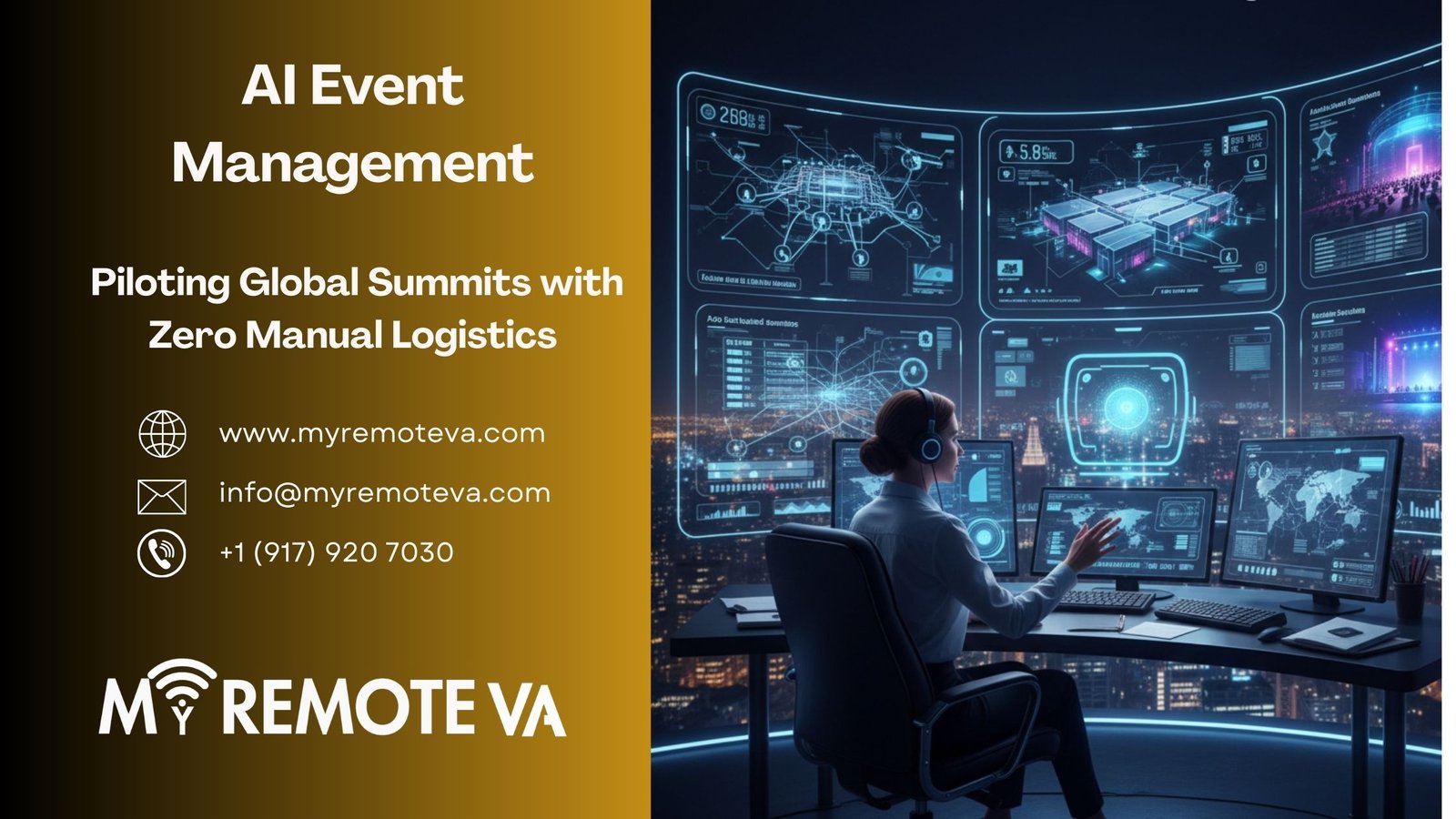
On the day itself, your VA operates as a remote command center. They monitor registration check-ins, manage last-minute attendee queries, coordinate with on-site or platform support, and handle any issues before they reach you.
For hybrid and virtual events, your VA manages the platform, moderates Q&A queues, tracks session attendance, and ensures speakers are briefed and ready. For in-person events, they coordinate with vendors, track the run sheet, and communicate with your on-site team in real time.
AI-assisted tools allow your VA to deliver hyper-personalized attendee experiences at scale. Attendees can receive custom session recommendations based on their professional profile, personalized schedules built from their registration preferences, and targeted content delivered to their inbox during and after the event.
For events where photography is involved, AI-powered photo delivery tools can identify attendees within minutes of images being captured and send each person a direct link to every professional photo they appear in. This kind of detail, delivered automatically, leaves a strong impression without any manual effort from your team.
After the Event: Follow-Up and Content Repurposing
The post-event window is where most businesses underperform. The conversation is warm, intent is high, and attendees are primed to take the next step. But if follow-up is delayed by days because the team is recovering from the event itself, that window closes.
A virtual assistant handles post-event follow-up as a pre-built workflow. Thank-you emails go out within hours. Survey links are sent at the optimal time for response rates. Leads are segmented in your CRM based on session attendance, engagement levels, and registration data, and routed to the appropriate sales or nurture sequence.
Event recordings are processed, captioned, and repurposed. Highlight clips are prepared for social media. Blog posts and email content are drafted from session transcripts. The event that took weeks to build continues generating value for months after it ends.
Who This Is For
Virtual assistant event management support is particularly well-suited to certain business types and use cases.
Coaches and consultants who run regular live workshops, masterminds, or retreats often find that the planning overhead makes events feel more burdensome than valuable. A VA changes that calculation entirely by absorbing the logistics so the host can focus entirely on delivery.
Founders and executives hosting investor briefings, partner summits, or company offsites need a level of coordination that their internal team rarely has time for. A VA with event management experience can handle the full scope professionally, at a fraction of the cost of an event agency.
Marketing teams running webinars, product launches, or virtual conferences benefit from a VA who manages the platform, communication sequences, and post-event analytics without adding headcount.
Any business planning to host events more consistently as a growth or client retention strategy needs a repeatable system, not a one-off project. A virtual assistant builds that system and improves it with every event.
Why Delegating Event Logistics Pays for Itself
The true cost of managing event logistics in-house is rarely just the hours spent on admin. It is the strategic attention diverted away from higher-value work, the quality of output that suffers when a non-specialist is managing an unfamiliar process, and the post-event momentum that is lost because the team has nothing left to give.
A virtual assistant who specializes in AI-assisted event coordination delivers a level of organization, personalization, and follow-through that most lean teams genuinely cannot match on their own. And because the same workflows can be reused, refined, and scaled across multiple events, the return on that investment compounds over time.
The goal is not just a well-run event. It is a well-run event that required almost nothing from you to pull off.
FAQ
Can a virtual assistant manage both virtual and in-person events? Yes. A VA can coordinate virtual events entirely remotely, managing platforms, communications, and attendee experience from any location. For in-person events, they serve as a remote logistics coordinator working alongside your on-site contacts, managing the run sheet, vendor communication, and real-time troubleshooting.
What size of event can a VA realistically handle? A skilled VA can support events ranging from small executive roundtables of 20 people to hybrid summits of several thousand attendees. For larger events, the key is having the right systems in place well in advance, which is exactly what a good VA builds during the planning phase.
How far in advance should I bring a virtual assistant into event planning? Ideally four to six weeks before a smaller event, and eight to twelve weeks before a large summit or conference. The earlier a VA is involved, the more they can build proactively rather than reactively.
Do I need to use specific platforms or tools for AI-assisted event management? No. A virtual assistant with event management experience can work within your preferred stack, whether that is Eventbrite, Hopin, Zoom Webinars, Airmeet, or a custom registration setup. Part of their value is adapting to your existing systems rather than requiring you to change them.
How does AI improve the attendee experience at events? AI tools allow a VA to personalize the attendee journey at scale, from custom session recommendations and pre-event content tailored to individual profiles, to automated photo delivery and post-event follow-up sequences timed for maximum engagement. These touches significantly improve attendee satisfaction without adding manual work for your team.
What happens after the event? Does the VA handle follow-up too? Yes, and this is one of the most valuable parts of the engagement. A VA manages post-event communications, lead segmentation, CRM updates, survey distribution, content repurposing, and the handoff of warm leads to your sales process, all within the critical 24 to 48-hour window after the event ends.