
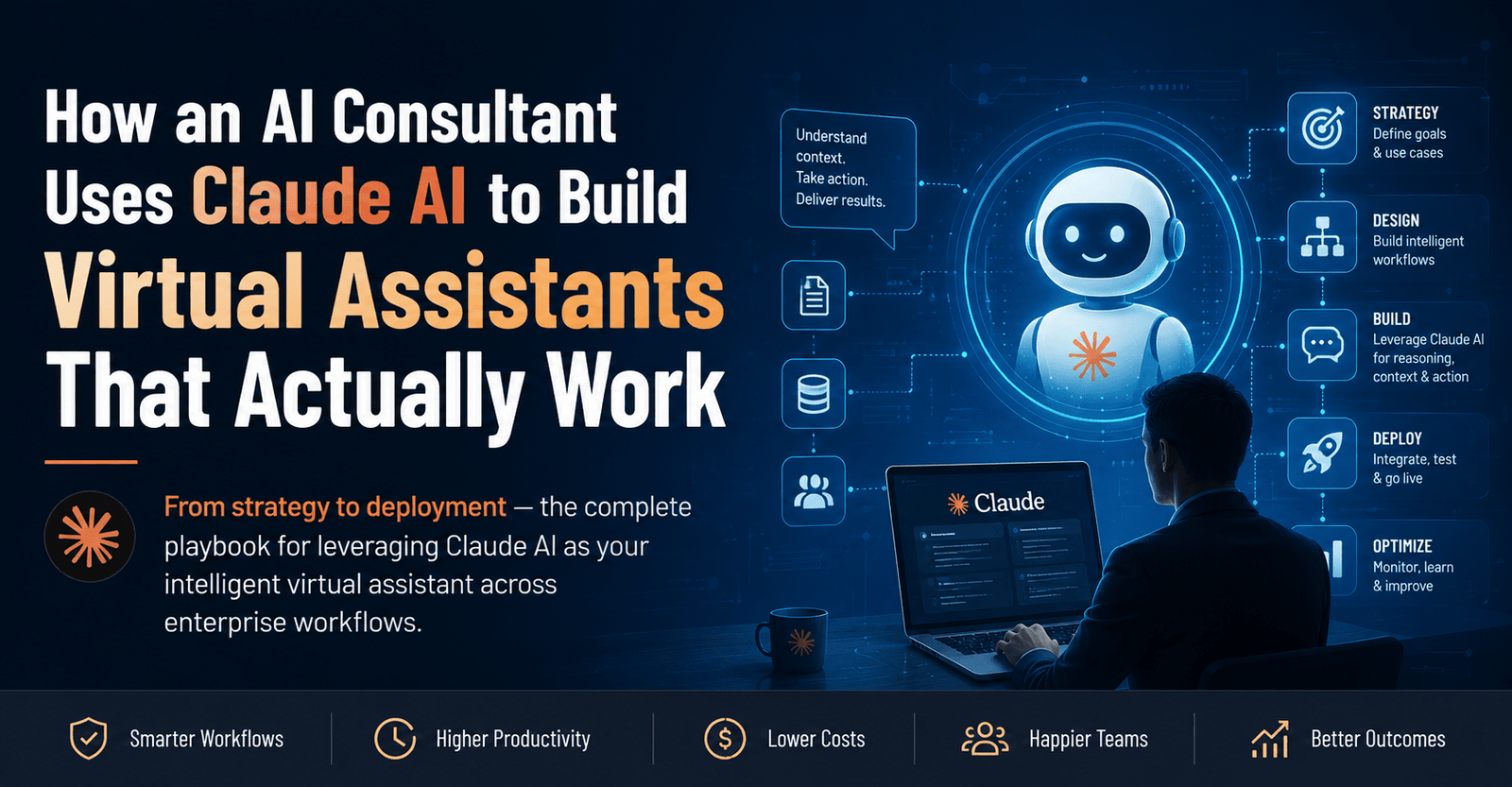
An AI consultant uses Claude AI to build virtual assistants by integrating natural language processing and machine learning capabilities to create customized and efficient automated workflows that improve productivity and customer experience through effective task management and data analysis.
- What Is an AI Consultant — and Why Does It Matter in 2026?
- Understanding Claude AI: More Than Just a Chatbot
- The Modern Virtual Assistant: What Businesses Actually Need
- How an AI Consultant Delivers a Claude AI Virtual Assistant Project
- Claude AI vs. Other Platforms: An AI Consultant’s Honest Comparison
- Calculating ROI for Your Claude AI Virtual Assistant
- How to Choose the Right AI Consultant for Your Claude AI Project
- Frequently Asked Questions About AI Consultants, Claude AI, and Virtual Assistants
- Conclusion: The Strategic Case for an AI Consultant in Your Claude AI Journey
What Is an AI Consultant — and Why Does It Matter in 2026?
An AI consultant is a specialist who helps organizations identify, design, and implement artificial intelligence solutions that drive measurable business outcomes. Unlike generic technology consultants, an AI consultant brings deep expertise in machine learning systems, large language models (LLMs), workflow automation, and — critically — the responsible deployment of AI in regulated environments.
In 2026, the demand for skilled AI consultants has accelerated beyond any prior forecast. Companies that delayed AI adoption are now scrambling to close the gap, while early adopters are scaling their implementations. The difference between success and failure increasingly comes down to one question: do you have the right AI consultant, using the right tools?
of enterprises plan to deploy AI virtual assistants by end of 2026
average ROI reported from AI consultant-led deployments
token context window — Claude AI’s enterprise advantage
projected global AI consulting market by 2028
This guide covers everything a business decision-maker, developer, or procurement team needs to know about working with an AI consultant to deploy Claude AI as a powerful virtual assistant platform.
Understanding Claude AI: More Than Just a Chatbot
Claude AI is an advanced large language model developed by Anthropic, built on Constitutional AI principles that prioritize safety, reliability, and predictable behavior in production environments. For an AI consultant evaluating LLM platforms, Claude stands out for a specific cluster of enterprise-critical capabilities.
What Makes Claude AI Different from Other LLMs
The AI landscape is crowded. GPT-4, Gemini, Llama 3, Mistral — every platform claims superiority. But when an experienced AI consultant evaluates models for sustained enterprise deployment, the shortlist narrows quickly. Here is why Claude AI consistently earns top consideration:
Constitutional AI training means Claude is trained not just on what to say, but on values-aligned principles for how to reason. The result is a model that is significantly less prone to hallucination, harmful outputs, and prompt injection attacks than equivalents without equivalent safety frameworks.
For enterprise workloads — customer-facing virtual assistants, regulated document workflows, financial analysis — this predictability is not a nice-to-have. It is operationally essential.
Core Capabilities Every AI Consultant Should Know
1. Long-Context Understanding (200,000 Tokens)
Claude AI processes up to 200,000 tokens in a single context window — enough to ingest an entire codebase, 500-page legal contract, or multi-year financial report and reason across it coherently. Most competing models degrade in quality as context length grows. Claude maintains accuracy across the full window, making it uniquely valuable for document-heavy enterprise workflows.
2. Structured Reasoning and Multi-Step Problem Solving
Claude is engineered for complex, multi-step reasoning tasks: breaking down ambiguous problems, following nuanced instructions, and producing structured, consistent outputs. For an AI consultant building a virtual assistant that handles contract analysis, code review, or research synthesis, reasoning depth matters far more than conversational fluency.
3. Native Tool Use and Agentic Capabilities
Claude’s API supports function calling, tool use, and structured output generation — the building blocks for autonomous agents that can take actions, query external systems, and complete multi-step tasks. Combined with Model Context Protocol (MCP) support, Claude integrates into complex enterprise workflows with precise control over access and permissions.
4. Multimodal Input: Text and Vision
Claude processes both text and images — interpreting charts, screenshots, diagrams, scanned documents, and visual data alongside natural language instructions. This enables use cases like automated form extraction, visual QA pipelines, and accessibility tooling without requiring separate vision and language model pipelines.
5. Enterprise Security and Compliance Readiness
Claude is available via the Anthropic API with SOC 2 Type II certification and HIPAA-eligible configurations. Data submitted through the API is not used to train future models by default — a critical distinction for organizations handling sensitive personal, financial, or healthcare data.
The Modern Virtual Assistant: What Businesses Actually Need
The term virtual assistant has evolved dramatically. Early virtual assistants answered FAQs from a decision tree. Today’s AI-powered virtual assistants, built on models like Claude, are capable of reasoning, drafting, analyzing, and executing multi-step workflows with minimal human intervention.
The Gap Between Expectation and Reality
Most organizations that attempt to build a virtual assistant without an AI consultant discover the same painful truth: technology alone does not solve the problem. A virtual assistant fails not because the underlying model is bad, but because the deployment was not designed for the real complexity of business operations.
Common failure modes include: vague system prompts that produce inconsistent outputs; no memory management strategy across conversations; missing integration with the systems employees actually use; no guardrails for compliance-sensitive queries; and no feedback loop to improve the assistant over time.
An experienced AI consultant addresses each of these failure modes before they become expensive problems.
What a Claude AI Virtual Assistant Can Do in 2026
Intelligent Tier-1 Support with Escalation Logic
A Claude AI virtual assistant handles complex customer queries, interprets account history, drafts resolution responses, and escalates to human agents only when genuinely needed — with full context handoff. Resolution rates above 70% are achievable for well-scoped deployments.
Internal Knowledge Assistant for Enterprises
Employees query policies, procedures, and institutional knowledge through natural language. Claude synthesizes answers from multiple internal documents — handbooks, wikis, contracts, past decisions — rather than returning a ranked list of links. The result is faster onboarding, fewer repeated questions, and senior staff freed from interruptions.
Contract Review and Clause Analysis
A Claude AI virtual assistant ingests full contract documents and flags non-standard clauses, summarizes obligations, identifies missing provisions, and generates redline suggestions — in minutes rather than hours. With human oversight integrated at key review points, this is compliant, auditable, and dramatically faster than manual review.
Financial Report Summarization and Scenario Analysis
Claude processes earnings reports, regulatory filings, and internal financial models to produce structured summaries, variance analyses, and natural-language explanations for non-technical stakeholders. An AI consultant integrates this with your BI stack so the assistant can pull live data on demand.
AI-Augmented Engineering Workflows
Developer-facing virtual assistants built on Claude assist with code review, documentation generation, test writing, and architectural decision support. With full codebase context, Claude provides advice that is specific to your stack — not generic examples from the internet.
How an AI Consultant Delivers a Claude AI Virtual Assistant Project
Every successful AI virtual assistant deployment follows a structured engagement model. Here is the process a qualified AI consultant should walk you through — and what you should be skeptical of if it is absent.
Discovery and AI Readiness Assessment
Before any model is selected or architecture designed, the AI consultant audits your current processes, data infrastructure, compliance requirements, and organizational readiness. High-value use cases are identified and prioritized. This stage prevents expensive misalignment between technical capability and business need.
Use Case Design and Scope Definition
Specific virtual assistant functions are defined in detail: what the assistant can and cannot do, which data sources it accesses, what escalation paths exist, and how success is measured. A well-scoped virtual assistant outperforms a broadly-scoped one consistently.
Prompt Engineering and System Architecture
The AI consultant designs system prompts, context injection strategies, memory management patterns, and tool use configurations. For Claude AI, this includes calibrating the assistant’s persona, constraints, escalation triggers, and output formats. This is where most DIY deployments fail — and where specialist expertise pays the highest return.
Integration and Backend Development
The Claude API is integrated with your existing CRM, ERP, knowledge base, ticketing system, and communication platforms. The AI consultant builds proper rate limit handling, prompt versioning, cost monitoring, and fallback logic. APIs are connected securely, with access controls appropriate to data sensitivity.
Guardrails, Testing, and Compliance Review
Output validation layers, audit logging, content filtering, and human-in-the-loop review workflows are built into the deployment. For regulated industries, the AI consultant documents decision trails and ensures alignment with HIPAA, SOC 2, GDPR, or applicable frameworks. Red-team testing identifies edge cases before launch.
Launch, Feedback Loop, and Continuous Optimization
Post-launch, the AI consultant establishes monitoring dashboards, user feedback collection, and a cadence for prompt and configuration updates. A Claude AI virtual assistant improves significantly in the first 90 days post-launch as real usage patterns surface optimization opportunities invisible during testing.
Claude AI vs. Other Platforms: An AI Consultant’s Honest Comparison
When an AI consultant recommends Claude AI over alternatives, the recommendation should be evidence-based, not vendor-driven. Here is a frank comparison across dimensions that matter most for virtual assistant deployments:
| Dimension | Claude AI | GPT-4o | Gemini 1.5 Pro |
|---|---|---|---|
| Context Window | 200K tokens | 128K tokens | 1M tokens* |
| Safety Architecture | Constitutional AI | RLHF + filters | RLHF + filters |
| Enterprise Compliance | SOC 2 Type II + HIPAA | SOC 2 + BAA | SOC 2 + BAA |
| Hallucination Rate (long doc) | Lower (independent evals) | Moderate | Moderate |
| Tool Use / Function Calling | Yes — MCP native | Yes | Yes |
| No training on API data | Yes (default) | Yes (Enterprise) | Yes (Enterprise) |
| Multimodal (text + vision) | Yes | Yes | Yes |
| Best for long-document workflows | Yes — maintains quality | Degrades at length | Variable quality |
*Gemini’s 1M context is available but independent evaluations show significant quality degradation at lengths above 200K tokens, making Claude the practical leader for document-heavy enterprise use cases.
An AI consultant’s honest take: No single model is universally superior. Claude AI has clear advantages in safety architecture, long-document coherence, and compliance-critical deployments. GPT-4o leads in code generation benchmarks. Gemini Pro integrates natively with Google Workspace. A good AI consultant recommends based on your specific use case — not a blanket preference.
Calculating ROI for Your Claude AI Virtual Assistant
One of the most common questions an AI consultant fields is: what will this actually deliver? The honest answer is that ROI varies significantly by use case, quality of implementation, and how well the virtual assistant is embedded into existing workflows. Here is a framework for realistic estimation.
Direct Cost Reduction
The clearest ROI comes from automating tasks that currently consume expensive human time. A customer support virtual assistant handling 2,000 tickets per month at an average human handling time of 12 minutes per ticket represents 400 hours of labor. At a fully-loaded cost of $35/hour, that is $14,000 per month — against Claude API costs typically in the range of $200–$500 for equivalent volume at current pricing.
Indirect Value Creation
Harder to quantify but often larger: senior staff freed from routine queries, faster decision-making from on-demand analysis, reduced onboarding time, lower error rates in document-intensive processes, and improved employee and customer experience scores. A skilled AI consultant helps you instrument these metrics from day one so value is visible to leadership, not just the implementation team.
Risk-Adjusted Thinking
AI consultants who have seen both successes and failures are candid about one reality: a poorly implemented Claude AI virtual assistant can create more cost than it saves — through hallucinated outputs acted upon without review, compliance gaps, or employee distrust that stalls adoption. Investing in quality AI consulting at the front end is not a cost — it is insurance against the far larger cost of a failed deployment.
How to Choose the Right AI Consultant for Your Claude AI Project
The AI consulting market has grown explosively, and with it, the number of vendors who claim Claude AI expertise without demonstrable depth. Here is what to look for — and what to walk away from.
Green Flags
Demonstrated Anthropic API Experience
Ask for specific examples of production Claude AI deployments — not demos or prototypes, but live systems with measurable outcomes. A credible AI consultant should be able to discuss prompt engineering decisions, context management strategies, and how they handled edge cases in real deployments.
Industry-Specific Domain Knowledge
The best AI consultants combine LLM expertise with deep knowledge of your industry. A healthcare AI consultant understands HIPAA, clinical workflows, and the specific failure modes of AI in patient-facing contexts. A financial services AI consultant understands regulatory constraints around AI-assisted decision-making. Domain knowledge shapes every architecture decision.
Honest About Limitations
Any AI consultant who promises that Claude AI will solve everything is not a consultant you want. The field’s best practitioners are the most candid about what current LLMs cannot reliably do — and design their architectures around those limitations rather than hiding them.
Red Flags
No Discussion of Guardrails or Compliance
If a vendor’s proposal jumps straight to features and API calls without mentioning output validation, human oversight workflows, and compliance documentation, the deployment will eventually create risk — just on your timeline, not theirs.
Overpromised Timelines
A production-ready Claude AI virtual assistant for an enterprise context realistically requires 8–16 weeks of engagement for an initial scope. Vendors offering fully functional deployments in two weeks are either descoping the problem to triviality or setting expectations they cannot meet.
Frequently Asked Questions About AI Consultants, Claude AI, and Virtual Assistants
What is the difference between an AI consultant and an AI developer?
An AI developer builds the technical implementation — API integrations, backend architecture, prompt pipelines, and deployment infrastructure. An AI consultant operates at a higher level, diagnosing business problems, designing the overall AI strategy, selecting appropriate models and approaches, and ensuring that technical work aligns with measurable business outcomes. In practice, many engagements require both roles, and the best AI consultants bridge both domains.
Is Claude AI suitable for small and medium-sized businesses, or only enterprise?
Claude AI is accessible at multiple price points through the Anthropic API, making it viable for businesses of any size. The architecture and complexity of the virtual assistant scales with business need. A small business might start with a focused customer-facing FAQ assistant, while an enterprise deploys a multi-agent system across operations, legal, and finance. An AI consultant helps right-size the implementation.
How long does it take to deploy a Claude AI virtual assistant?
Timeline depends on scope and integration complexity. A focused internal knowledge assistant with limited integrations can be production-ready in 4–6 weeks. A customer-facing virtual assistant integrated with CRM, ticketing, and escalation workflows typically requires 10–16 weeks for a quality deployment. Complex multi-agent systems with custom tooling may run 6 months or more. Any AI consultant quoting dramatically shorter timelines for complex scope should be pressed for specifics.
Can Claude AI handle languages other than English?
Yes. Claude AI demonstrates strong multilingual performance across major world languages including Spanish, French, German, Japanese, Mandarin, Hindi, Arabic, and Portuguese. For virtual assistant deployments targeting non-English-speaking users or global enterprise workforces, an AI consultant should include multilingual testing as a standard part of the quality assurance process.
What is the cost of working with an AI consultant for a Claude AI project?
AI consulting engagement costs vary widely by scope, consultant experience, and geography. Strategy and roadmapping engagements for a defined use case typically range from $8,000 to $30,000. Full implementation engagements — from discovery through production deployment — range from $40,000 to $200,000+ for complex enterprise scopes. Ongoing managed services and optimization retainers typically run $3,000–$15,000 per month. These figures should be evaluated against the ROI framework above, not in isolation.
Does Anthropic use my data to train Claude AI if I use the API?
No. By default, data submitted through the Anthropic API is not used to train future Claude AI models. This is a baseline privacy protection that applies to all API users, distinguishing it from consumer-facing product terms. For organizations in regulated industries, Anthropic also offers enterprise agreements with additional data handling commitments. Your AI consultant should confirm the specific terms applicable to your deployment.
What is the difference between a virtual assistant and an AI agent?
A virtual assistant typically refers to an AI system that responds to user queries — a reactive, conversational interface. An AI agent is a more autonomous system that proactively takes actions, uses tools, and completes multi-step tasks with minimal human instruction per step. Claude AI supports both patterns. An AI consultant helps determine which architecture is appropriate: most enterprise deployments begin with a virtual assistant and evolve toward agentic capabilities as trust and infrastructure mature.
Conclusion: The Strategic Case for an AI Consultant in Your Claude AI Journey
The organizations seeing the highest returns from Claude AI virtual assistant deployments share a common thread: they did not treat AI as a technology project. They treated it as a business transformation initiative, led by people who understood both the technical landscape and the operational realities of their specific industry.
An AI consultant is not a luxury for large enterprises. It is the mechanism by which organizations of any size avoid the $200,000 failed deployment and instead build the $1,400,000-per-year operational efficiency engine. The cost of expertise is real. The cost of its absence is larger.
Claude AI, deployed by a skilled AI consultant into a well-architected virtual assistant, represents a genuine competitive advantage — not because the technology is magic, but because most organizations are still deploying it carelessly. The window for differentiation is open. The question is whether you walk through it strategically or reactively.
Ready to evaluate your AI readiness? The first step is an honest assessment of where your organization stands — which processes are candidates for AI virtual assistant automation, what data infrastructure exists to support it, and what compliance obligations apply. A good AI consultant begins here, not with a product pitch.
Ready to Get Started?
Sign up today and get matched with the perfect remote executive assistant.
Register NowAn ai consultant uses Claude to build effective virtual assistants and an ai consultant uses Claude for the same purpose, leveraging its capabilities to drive results, as an ai consultant uses Claude to streamline processes. This approach yields success.







No comments on this post yet.