
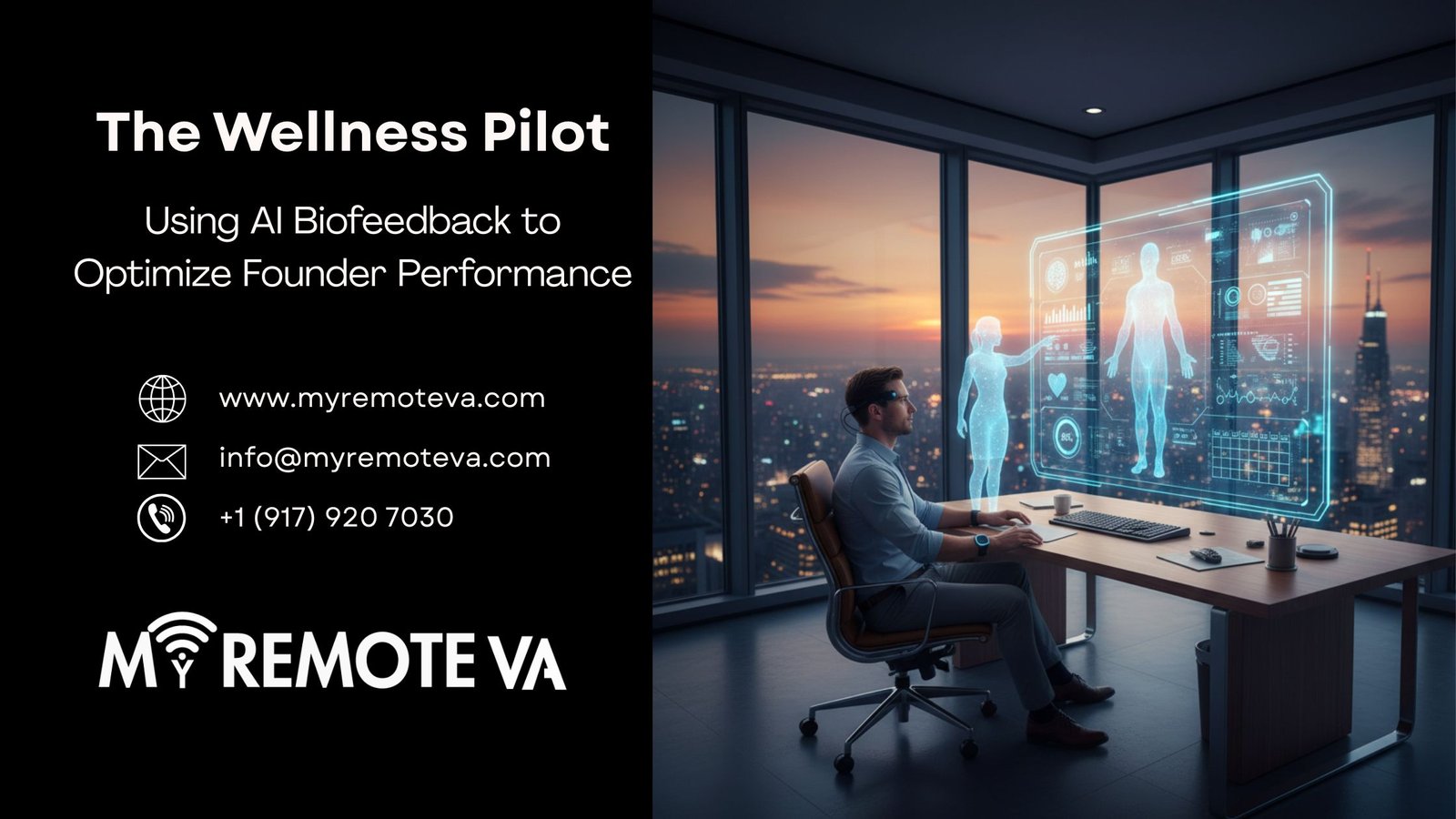
The Wellness Pilot utilizes AI biofeedback to monitor and optimize founder performance by tracking physical and mental well-being, providing personalized recommendations to enhance productivity and overall health through data-driven insights and virtual support.
Unlock Your VA Potential
Explore resources, guides, and tools designed to scale your business.
Visit the Intelligence Hub- What AI Biofeedback Data Actually Tells You
- How a Virtual Assistant Translates Biofeedback into Calendar Intelligence
- The Bio-Augmented Daily Schedule: What It Looks Like in Practice
- Comparing VA Support Models for Executive Wellness and Performance Management
- The Productivity Cost of Ignoring Biofeedback
- Building Your Bio-Augmented Performance System: Where to Start
- FAQ
A virtual assistant can optimize founder performance using AI biofeedback by aggregating data from wearables (Oura Ring, Whoop, CGMs), summarizing weekly health trends, and surfacing scheduling recommendations — so founders act on their biometric data instead of ignoring it.
Founders using biofeedback wearables collect hundreds of data points daily but rarely have time to interpret them. A trained VA handles the data layer: pulling reports, spotting anomalies, and translating metrics into actionable schedule or lifestyle adjustments without adding another cognitive task to the founder’s day.
The premise is straightforward. Your business performance is a direct output of your personal performance. The quality of your decisions, the clarity of your thinking, your ability to read a room, stay patient under pressure, and think strategically rather than reactively: all of it is affected by your physiological state. Sleep debt, poor nutrition timing, cortisol load, and lack of genuine recovery do not just make you feel worse. They measurably degrade the quality of every output you produce.
Elite athletes have known this for decades. They treat physical data as operational intelligence. Founders in 2026 are increasingly applying the same logic, and the virtual assistants who help manage that data are delivering a category of support that goes well beyond administrative assistance.
What AI Biofeedback Data Actually Tells You
The wearable technology available to founders today generates a remarkable volume of useful physiological data. Devices like Oura rings, Whoop straps, Apple Watch, Garmin wearables, and Continuous Glucose Monitors (CGMs) collect data points that paint a detailed picture of how ready your body and mind are to perform on any given day.
The challenge is that most people collect this data and do nothing actionable with it. They glance at a readiness score, note that it is lower than usual, and proceed with exactly the same schedule they had planned regardless. The data becomes an interesting observation rather than an operational input.
When a virtual assistant is managing your calendar and schedule with access to this data, that changes. The readiness score becomes a scheduling variable. The sleep quality data becomes a reason to shift a high-stakes meeting. The glucose trend becomes context for a lunch order or a well-timed break. The data stops being informational and starts being operational.
The key biofeedback signals a VA can work with include the following.
| Biofeedback Signal | What It Measures | Operational Implication |
|---|---|---|
| Readiness Score (Oura/Whoop) | Overall recovery and physiological preparedness | Determines cognitive task load for the day |
| HRV (Heart Rate Variability) | Nervous system recovery and stress resilience | Low HRV signals high stress load; schedule accordingly |
| Sleep Quality and Duration | Deep sleep, REM cycles, disruptions | Poor sleep night triggers proactive schedule adjustment |
| Sleep Debt | Cumulative under-recovery over days | Flags when a recovery day or lighter schedule is needed |
| Resting Heart Rate Trend | Cardiovascular stress and illness indicators | Rising trend suggests reducing cognitive demand |
| Blood Glucose (CGM) | Energy stability and post-meal cognitive dips | Informs meal timing, lunch selection, and afternoon scheduling |
| Activity and Movement | Sedentary hours, steps, exercise load | Prompts movement breaks and flags insufficient activity |
| Body Temperature Variation | Early illness detection, hormonal cycles | Early warning system for upcoming energy dips |
How a Virtual Assistant Translates Biofeedback into Calendar Intelligence
Understanding the data is the first step. Acting on it intelligently, in a way that fits around your business commitments, is where the work actually happens. This is the layer a virtual assistant manages.
Adaptive Calendar Management
A VA with access to your readiness data does not simply follow a fixed schedule. They actively adjust it based on what your biofeedback is showing each morning.
On a high-readiness day, when your HRV is strong and sleep quality was excellent, your VA schedules your most cognitively demanding work in your peak window: complex decisions, high-stakes negotiations, strategy sessions, and creative problem-solving. These are the hours where your brain is genuinely operating at its best.
On a low-readiness day, following poor sleep or an accumulated stress load, your VA moves those high-demand tasks to a later window or reschedules them entirely. Lower-cognitive work such as inbox processing, routine approvals, and administrative reviews fills the morning instead. The day is still productive. The strategic work is protected.
This is not about doing less. It is about doing the right work at the right time based on actual physiological data rather than a fixed template that ignores how you actually feel.
Nutritional and Energy Timing Support
Blood glucose data from a CGM reveals something most founders experience but rarely connect to their schedule: the afternoon energy dip is not inevitable. It is largely predictable and largely preventable with the right meal composition and timing.
A VA monitoring glucose trends can identify the pattern specific to you, which foods and meal timings produce a stable afternoon energy window versus which ones cause the kind of post-lunch crash that destroys your 3pm productivity. Over time, this builds a personal nutrition profile that informs meal ordering, snack timing, and the scheduling of your most important afternoon work.
On a practical level, this might mean your VA orders lunch from a specific type of restaurant on board meeting days, schedules your most demanding afternoon sessions in the windows where your glucose history shows consistent stability, or adds a brief movement break at the point where your data typically shows a dip.
Recovery Orchestration and Digital Sunset Scheduling
Genuine recovery is the most undervalued performance variable in most founders’ schedules. The brain does not maintain peak cognitive function through continuous effort. It requires cyclical periods of low stimulation, and most founders are running significant recovery deficits without realizing how much that affects their output quality.
A VA builds structured recovery into your day as non-negotiable calendar blocks rather than aspirational intentions that get deleted when something urgent appears. These include protected deep work periods where notifications are silenced and auto-responses handle non-urgent communications, mandatory mid-day breaks timed to your biofeedback data, and a daily digital sunset window in the evening where your VA handles any remaining communications and marks the end of your cognitive work day.
The digital sunset is particularly valuable. Research consistently shows that wind-down time before sleep, free from screens and decision-making, significantly improves sleep quality. A VA who manages your evening communications and creates that protected transition period is directly improving the readiness data you wake up to the following morning.
The Bio-Augmented Daily Schedule: What It Looks Like in Practice
The table below illustrates how the same founder’s day looks differently under a standard fixed schedule versus a bio-augmented adaptive schedule managed by a VA.
| Time | Standard Fixed Schedule | Bio-Augmented VA-Managed Schedule |
|---|---|---|
| 7:00 AM | Check emails immediately on waking | VA reviews overnight messages; founder wakes to a clean brief |
| 8:00 AM | Back-to-back calls regardless of readiness | VA checks readiness score; adjusts morning task load if low |
| 9:00 AM | Strategy session as scheduled | Strategy session held only if readiness is above threshold; otherwise moved |
| 10:30 AM | Continue working through | VA prompts movement break based on sedentary data |
| 12:00 PM | Grab whatever is convenient for lunch | VA has ordered lunch timed and composed for stable afternoon glucose |
| 1:00 PM | Post-lunch cognitive dip | Protected focus block; glucose-timed for peak afternoon performance |
| 3:00 PM | Board meeting or high-stakes call | Scheduled in the window where data shows consistent peak performance |
| 5:30 PM | Continue responding to messages | VA begins handling non-urgent comms; digital sunset window begins |
| 9:00 PM | Still on devices, struggling to wind down | VA has auto-responded to remaining messages; screen-free wind-down begins |
| Sleep | Disrupted, lower HRV by morning | Structured wind-down produces stronger sleep quality and readiness scores |
The difference is not dramatic in any single day. Compounded across weeks and months, the gap in decision quality, creative output, and strategic clarity becomes significant.
Comparing VA Support Models for Executive Wellness and Performance Management
Not all virtual assistant services are set up to deliver this level of integrated, proactive support. The comparison below assesses how six global VA sourcing regions handle the specific demands of executive wellness and performance management.
| Criteria | India (e.g., MyRemoteVA) | Philippines (e.g., Virtual Staff Finder) | United States (e.g., Belay) | United Kingdom (e.g., Virtalent) | Pakistan (e.g., TaskBullet) | Eastern Europe (e.g., Outsource Workers) |
|---|---|---|---|---|---|---|
| Avg. Monthly Cost (20 hrs/wk) | $300 to $600 | $400 to $800 | $1,500 to $3,000 | $1,200 to $2,500 | $250 to $500 | $600 to $1,200 |
| Proactive Calendar Optimization | Strong, data-driven | Moderate, instruction-driven | Moderate, high touch | Moderate, high touch | Basic, reactive | Moderate |
| Biofeedback Tool Familiarity | High, actively trained | Emerging | Low to Moderate | Low to Moderate | Low | Moderate |
| Adaptive Scheduling Capability | Strong | Moderate | Moderate | Moderate | Basic | Moderate |
| Nutritional and Meal Coordination | Comfortable with integration | Comfortable | Moderate | Moderate | Basic | Basic |
| Recovery and Digital Sunset Management | Strong | Moderate | Moderate | Moderate | Basic | Moderate |
| Communication Buffer Management | Strong, AI-assisted | Strong | Strong | Strong | Moderate | Moderate |
| Discretion with Health Data | Team-supervised, NDA standard | Self-managed | High, vetted | High, vetted | Self-managed | Self-managed |
| Time Zone Coverage for Morning Readiness Review | Excellent (IST covers US AM) | Good (PHT overlaps US hours) | US business hours only | GMT, UK hours only | Good (PKT flexible) | EU hours, limited US AM |
| Scalability Across Multiple Executive Schedules | Very High | High | Low | Low | Moderate | Moderate |
| Entry Tier or Free Trial | Yes (Forever Free tier) | No | No | No | Limited | No |
| Best Suited For | Full bio-augmented schedule management | Standard calendar and admin support | Senior executive, US context | Professional services, UK context | High-volume admin tasks | Technical and operational support |
What the Comparison Reveals
Executive wellness and performance management requires a VA who is proactive by default, not reactive on instruction. The value here comes from the VA acting before you ask them to, adjusting your schedule based on data you may not have even checked yet, flagging a recovery risk before it becomes a bad week, and protecting your high-value cognitive windows without waiting for direction.
US and UK-based VA services offer strong professionalism and communication but are structured around high-touch, instruction-driven relationships that are expensive at the engagement level this kind of continuous management requires. Philippine-based talent offers solid general support but biofeedback tool integration is still at an early stage across most providers.
India-based AI-assisted VA services, particularly those with structured team oversight and proactive workflow design, are currently the strongest fit for this use case. The combination of analytical capability, AI tool proficiency, timezone coverage that naturally overlaps with US and UK morning windows, and a cost structure that enables ongoing daily engagement rather than occasional project support makes them the practical choice for founders taking their performance management seriously.
The Productivity Cost of Ignoring Biofeedback
The counterargument to all of this is that it sounds like a lot of infrastructure for a marginal gain. Most founders would push back with: I have always just worked hard and figured it out.
The problem with that argument is that it treats cognitive performance as binary: either you can work or you cannot. The reality is that performance exists on a spectrum, and most founders are spending a significant portion of their working hours in a suboptimal zone without recognizing it because there is no obvious signal that they are underperforming relative to their actual ceiling.
A founder operating at 70% cognitive capacity because of accumulated sleep debt and poor recovery makes decisions that are measurably different from the same founder operating at 95%. The decisions feel equally confident in the moment. The quality is not equal. Over a year of compounded below-peak decisions, the gap in business outcomes is real.
The cost of not having a bio-augmented performance system is not visible on any balance sheet. It shows up in the opportunities missed, the deals not closed at their full potential, the strategic errors made under stress, and the creative solutions that never emerged because the conditions for genuine insight were never consistently created.
Building Your Bio-Augmented Performance System: Where to Start
For founders ready to move from gut-feel schedule management to data-driven performance optimization, the starting point does not require expensive equipment or a complex setup.
Begin with one wearable. An Oura ring or Whoop strap provides enough data to start working with a VA on adaptive calendar management. You do not need a CGM on day one. The sleep and readiness data alone is enough to change how your mornings are structured.
Brief your VA on your peak performance patterns. Every founder has a natural energy rhythm. Some are genuinely sharper in the morning. Others hit their cognitive peak mid-morning or early afternoon. Share what you know about your own patterns as a starting point before the biofeedback data confirms or challenges it.
Identify your three highest-value cognitive tasks. These are the activities where being at your best makes the biggest difference to your business. Strategy sessions, important sales conversations, complex problem-solving, and creative work all qualify. These are the tasks that need to be scheduled in your peak windows and protected from the reactive pull of the day.
Let your VA start with calendar protection. The most immediate and impactful change is simply having a VA hold your peak windows against encroachment by low-value meetings and reactive tasks. Even before biofeedback data is fully integrated, this single change typically produces a noticeable improvement in output quality within the first two weeks.
Build from there. As your VA develops familiarity with your data patterns and personal performance rhythms, the system becomes more refined, more predictive, and more effective over time.
FAQ
Does a virtual assistant need direct access to my health wearable data? Not necessarily. You can share a daily readiness summary, a screenshot of your scores, or a brief voice note each morning. The VA uses whatever format works for you. Many founders simply send a one-line morning update with their readiness score, and the VA adjusts the day from there.
Is it safe to share biofeedback data with a virtual assistant? The data involved, readiness scores, sleep quality ratings, and glucose trends, is general wellness information rather than sensitive medical data. A VA engaged under a proper confidentiality agreement handles it with the same discretion as any personal business information. The question to ask of any VA service is whether there is a formal NDA and team-level oversight in place.
What if I do not use a wearable device? The system still works with self-reported data. A VA can work from a simple morning check-in where you rate your energy and focus on a 1 to 10 scale. It is less precise than biofeedback data but still enables adaptive scheduling. The wearable data adds objectivity and removes the tendency to override low scores and push through when the data says you should not.
How does this differ from a standard executive assistant managing a calendar? A standard calendar manager follows a fixed schedule and books meetings on request. A bio-augmented performance VA actively manages the schedule as a dynamic system, adjusting it daily based on physiological data, protecting high-value windows proactively, and building recovery into the structure of the day as a non-negotiable component rather than an optional addition.
Can a virtual assistant manage this alongside other business support tasks? Yes. For most founders, the wellness and performance layer is one component of a broader VA engagement that also covers inbox management, meeting preparation, research, and operational support. The bio-augmented scheduling integrates naturally into a full executive support role rather than requiring a dedicated resource.
How quickly does this approach produce results? Most founders notice a difference in their sense of control and cognitive availability within the first two to three weeks of having a VA actively protect their peak windows and manage their recovery schedule. The biofeedback data integration typically produces measurable improvements in sleep quality and readiness scores within the first month as wind-down routines and recovery blocks become consistent.
Ready to Get Started?
Sign up today and get matched with the perfect remote executive assistant.
Register NowThe wellness pilot: virtual program leverages AI biofeedback to enhance founder performance, with the wellness pilot: virtual assistant at its core, and the wellness pilot: virtual framework guiding its implementation, ultimately optimizing overall well-being. This approach has proven effective.
The wellness pilot: virtual program utilizes AI biofeedback to enhance founder performance, as seen in the wellness pilot: virtual assistant's success. This wellness pilot: virtual model optimizes well-being. It proves the wellness pilot: virtual concept effective.










No comments on this post yet.